U.S. stock indexes closed lower Tuesday as investors monitored earnings reports and economic data ahead of inflation figures due later in the week.
The S&P 500 slipped 17.59 points, or 0.4%, to 4122.47. The Dow Jones Industrial Average slid 58.13 points, or 0.2%, to 32774.41 while the technology-heavy Nasdaq Composite fell 150.53 points, or 1.2%, to 12493.93.
The pace of the stock market’s rise as it continues a bounce off the June lows is nearing a magnitude that’s preceded “huge” moves in the past. The dilemma for investors is that those moves can be in “either direction,” analysts at Jefferies observed in a weekend note.
Through Friday, the S&P 500 SPX, +0.76% has bounced more than 13% off its 2022 closing low of 3,666.77, set on June 16. While the S&P 500 remains in a bear market, having tumbled more than 20% from its Jan. 3 record close, the Dow Jones Industrial Average DJIA, +0.76% will exit a market correction with a close above 32,877.66 while the Nasdaq Composite COMP, +1.04% would exit its brutal bear market with a finish above 12,775.32.
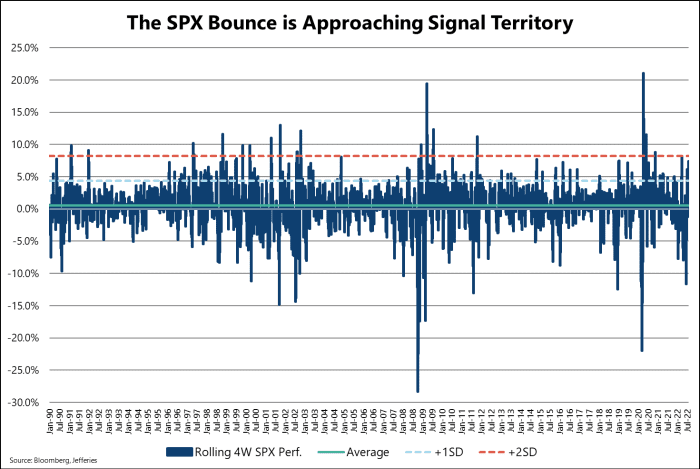
But it’s the large-cap benchmark S&P 500’s more-than-7% rise over the past four weeks that is “dangerously close to extremely interesting from a signal perspective,” wrote Jefferies strategists, including Andrew Greenebaum, in a Sunday note.
A rise of just more than 8% over four weeks would mark a two-standard deviation for S&P 500 rallies, they observed, based on data going back to 1990, which means the market won’t need “much more juice” to hit statistically significant territory.
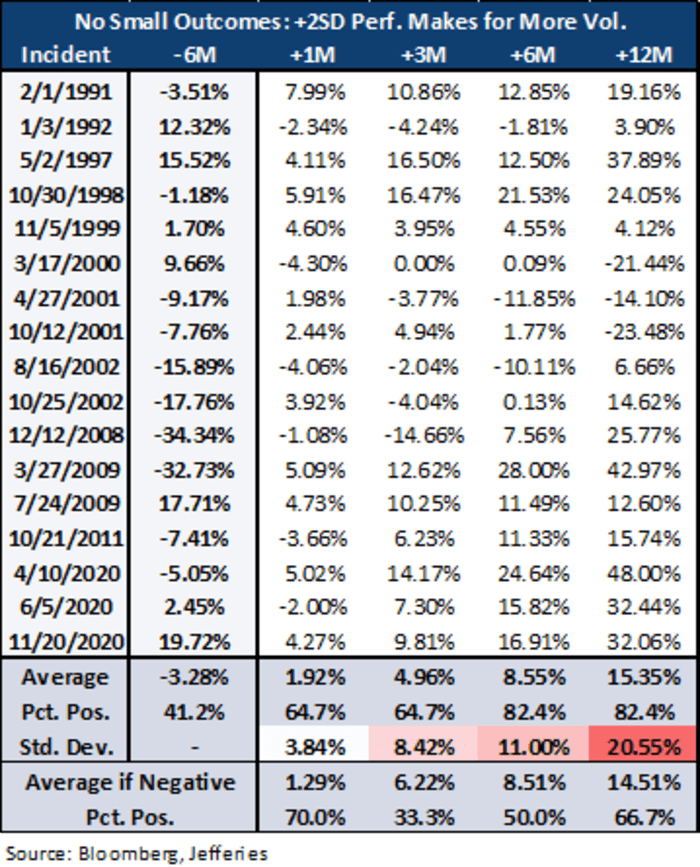
And in the 17 times the S&P 500 has hit that threshold, the subsequent performance “looks massive,” they wrote, averaging 9% over the next six months. But there’s a notable caveat in that there were also several instances that saw double-digit negative returns. And when the prior six months were negative — as would be the case this time around — “the likelihood of positive returns drops precipitously,” they wrote (see chart and table below).
Jefferies
Jefferies
The takeaway, they said, is that “while the seemingly unstoppable bounce may lure folks in, there is still a strong chance it’s just a (quite tradeable) bear market rally.”
from Stock Market News – My Blog https://ift.tt/1rFMN7G
via IFTTT
Investors have scoured reams of data for evidence that 2022’s market rout is over. A six-decade-old survey might have made that call in June.
Investors Intelligence’s ratio of bullish advisers to bearish ones, known as the bull/bear ratio, fell to 0.60 during the week of June 21. That was the survey’s most-pessimistic reading since the week of March 9, 2009, when it fell to 0.56, according to Yardeni Research. That date also marked the lowest closing level of the financial crisis, with stocks falling 57% from their October 2007 peak before skyrocketing.
from Stock Market News – My Blog https://ift.tt/uFZ8hJ9
via IFTTT
Here are the most important news items that investors need to start their trading day:
1. Stock futures fall after jobs report
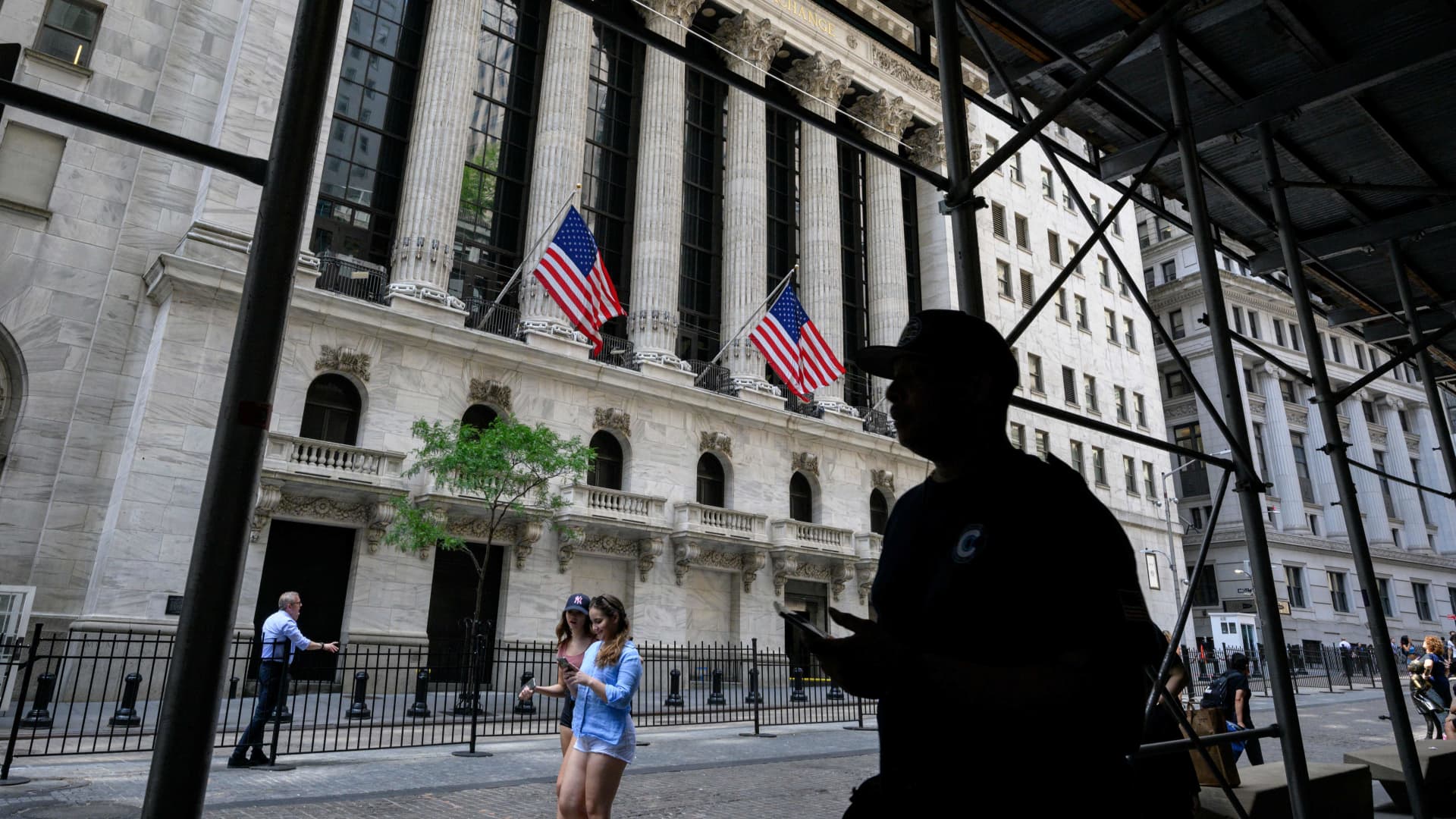
People walk past the New York Stock Exchange (NYSE) on Wall Street on July 12, 2022 in New York City.
Angela Weiss | AFP | Getty Images
Stock futures fell Friday morning after a much stronger-than-expected July nonfarm payrolls report, signaling to investors the Federal Reserve is likely to stay in rate-hiking mode. The move in futures was relatively muted prior to the release of the labor market data. On Thursday, Wall Street posted a mixed session. The Dow Jones Industrial Average fell 0.26%, its third negative day in four, while the S&P 500 lost merely 0.08% and remains positive week to date. The tech-heavy Nasdaq Composite, meanwhile, rose 0.41% to close at its highest level since May 4.
2. U.S. added 528,000 jobs in July
A man walks past a “We Are Hiring” sign in New York City on July 8, 2022.
Angela Weiss | AFP | Getty Images
The U.S. added 528,000 jobs in July, the Bureau of Labor Statistics said Friday, far exceeding the Dow Jones estimate of 258,000 and countering other recent data that suggested the economic recovery is slowing down. The unemployment rate fell to 3.5%, when economists had expected it to remain steady at 3.6%. Wages rose 0.5% on a month-over-month basis, topping estimates for a 0.3% gain. The sector with the most job gains in July was leisure and hospitality, with payrolls growing by 96,000.
3. China halts cooperation with U.S. on military, climate
China said Friday it’s putting a stop to cooperation with the U.S. on issues including climate change and military relations after House Speaker Nancy Pelosi earlier this week visited Taiwan, the democratic island that Beijing claims as its own territory. China also imposed sanctions on Pelosi personally for the visit, which further stoked tensions between the world’s two largest economies. U.S. Secretary of State Antony Blinken criticized China for launching missiles during military exercises near Taiwan this week, saying those actions represented an “extreme, disproportionate and escalatory” response, according to Reuters.
4. DoorDash pops and more earnings
An AFP journalist checks the DoorDash food delivery application on her smartphone on February 27, 2020 in Washington, DC.
Eric Baradat | AFP | Getty Images
DoorDash shares jumped more than 9% in premarket trading Friday, after the food delivery company’s second-quarter revenue exceeded expectations and orders delivered in the period reached an all-time high of 426 million. However, DoorDash reported a wider-than-expected loss of 72 cents per share and warned it anticipates a “softer consumer spending environment” in the third and fourth quarters.
In more earnings news:
Expedia Group posted strong earnings and revenue for the quarter ended June 30, sending shares up more than 4%, and CEO Peter Kern said “travel demand has remained strong” despite flight disruptions and economic uncertainty.
Ride-hailing company Lyft reported better-than-expected adjusted earnings, based on estimates compiled by FactSet, helping send shares higher by 7.5% in premarket trading.
5. Democrats reportedly add buyback tax to ‘Inflation Reduction Act’
Senator Kyrsten Sinema, a Democrat from Arizona, listens during a news conference in the Dirksen Senate Office Building in Washington, D.C., U.S., on Wednesday, July 28, 2021.
Stefani Reynolds | Bloomberg | Getty Images
Democrats in the Senate appear to have enough support to advance the so-called Inflation Reduction Act, and a 1% tax on stock buybacks is reportedly now part of the sweeping legislative proposal, CNBC’s Ylan Mui reported Friday morning. However, as a condition of garnering the backing of Sen. Kyrsten Sinema, D-Ariz., the bill no longer includes a change to the carried interest tax, which allows hedge fund and private equity investors to pay a lower rate. Read a full story on Sinema’s support for the legislation here.
— Sign up now for the CNBC Investing Club to follow Jim Cramer’s every stock move. Follow the broader market action like a pro onCNBC Pro.
from Stock Market News – My Blog https://ift.tt/DKa0qS5
via IFTTT
Vlad Tenev, the Robinhood chief executive, on the Nasdaq display last year. “This is on me,” he told employees in a blog post Tuesday, referring to the layoffs.Credit…Sasha Maslov for The New York Times
Robinhood, the trading app that popularized one-click trading and helped fuel last year’s meme stock frenzy, said on Tuesday that it was laying off about 23 percent of its work force.
Vlad Tenev, the chief executive of Robinhood, said in a blog post that the layoffs would affect employees across the company, especially those in operations, marketing and program management roles.
Robinhood declined to comment on the layoffs.
The announcement followed closely on the heels of cuts in April, when Robinhood laid off 340 workers, or about 9 percent of its employees at the time. Since then, Mr. Tenev wrote, further worsening of the economy, including inflation and the crash of the crypto market, has “reduced customer trading activity and assets under custody.” The price of Bitcoin has fallen by more than half this year, to about $23,000 per coin. The cryptocurrency rose as high as $66,000 in late 2021.
The layoffs come as part of a wave of job cuts at tech companies, including some cryptocurrency firms. In June, cryptocurrency exchanges including Coinbase and Gemini announced that they were laying off employees. Last week, Shopify, an online marketplace, announced it was cutting 10 percent of its 10,000 employees.
In his memo on Tuesday, Mr. Tenev said Robinhood misjudged the economy and trading activity. “As C.E.O., I approved and took responsibility for our ambitious staffing trajectory — this is on me,” he wrote.
The company also released its second-quarter results on Tuesday, reporting that its monthly count of active users declined to 14 million in June, a decrease of 1.9 million.
The turbulence represents a major comedown for Robinhood, which became a key player in the meme stock craze in early 2021, when investors banded together to drive up the stocks of companies including the video game retailer GameStop and the movie theater chain AMC. On Jan. 27, 2021, GameStop shares closed up nearly 1,800 percent from a few weeks before, a record. Then, Robinhood restricted trading in some meme stocks. The restrictions led the stocks to plunge. Lawsuits, a Securities and Exchange Commission investigation and congressional hearings soon followed.
Robinhood’s stock price soared during the meme-stock trading. On Aug. 7, 2021, the company was worth $46 billion, up about 60 percent from its valuation a week before. But its stock has plunged 50 percent since the beginning of the year as it continues to deal with the fallout.
The layoffs come at a challenging moment for financial technology companies.
Coinbase, the publicly traded cryptocurrency exchange, laid off 18 percent of its staff in June amid the crypto market crash. Other major crypto companies, like OpenSea, Gemini and Crypto.com, have also made job cuts.
“Everyone over-hired — Coinbase over-hired, Robinhood over-hired. When money was easy, they were just hiring, hiring, hiring,” said Dan Dolev, a senior analyst at Mizuho. “I’m not surprised to see these cuts.”
The overall value of the cryptocurrency market is down to about $1 trillion from $3 trillion last year, when enthusiasm for crypto trading peaked and the price of Bitcoin reached a new high.
Robinhood has been working to build out its crypto arm this year, listing new coins and rolling out a crypto wallet product. “The one thing that I liked the least about Robinhood is their crypto exposure,” Mr. Dolev said. “Anything that has no intrinsic value is always prone to problems.”
Also on Tuesday, the New York State Department of Financial Services announced it was fining Robinhood’s crypto operation $30 million over violations of its anti-money laundering and cybersecurity regulations.
“As its business grew, Robinhood Crypto failed to invest the proper resources and attention to develop and maintain a culture of compliance,” Adrienne A. Harris, the superintendent of financial services, said in a statement.
Cheryl Crumpton, associate general counsel at Robinhood, said in a statement that the company was “pleased” the settlement had been finalized. “We have made significant progress building industry-leading legal, compliance, and cybersecurity programs, and will continue to prioritize this work to best serve our customers,” she said.
from Stock Market News – My Blog https://ift.tt/GPjLDY0
via IFTTT
The stock market’s recent rally is “fragile” due to the potential for further downward earnings revisions heading toward 2023, according to RBC Capital Markets.
Forecasts for revenue and earnings per share, or EPS, have started to decline for the second half of this year and 2023, although company results for the second quarter have come in “much better than expected,” said Lori Calvasina, head of U.S. equity strategy at RBC, in a research note Wednesday.
While earnings “resilience” seen after more than half of the S&P 500’s results were in for the second quarter is “good news” for the U.S. stock market, she said the “bad news” is the risk of further downward earnings revisions later this year.
As companies began reporting second-quarter earnings, “many U.S. equity investors were hoping the ‘Band-Aid would get ripped off’,” wrote Calvasina. That is, “that company guidance and EPS forecasts on the sell-side would get cut dramatically, fully bake in an economic slowdown, and allow them to start buying stocks with some confidence about where multiples are really at.”
The S&P 500 was down almost 13% so far this year based on Wednesday afternoon trading at around 4,161 according to FactSet data, at last check.
According to the RBC report, much stronger-than-expected results for the second quarter have “painted a picture of resilience for corporate earnings and supported the narrative that any coming (or current) economic downturn is likely to be short and shallow.”
“That’s been supportive of stock prices over the past few weeks, but going forward it also tells us that the rally in stocks is fragile given the possibility of further downward earnings revisions as 2023 comes into view,” said Calvasina. “Forecasts are coming down, but perhaps not enough.”
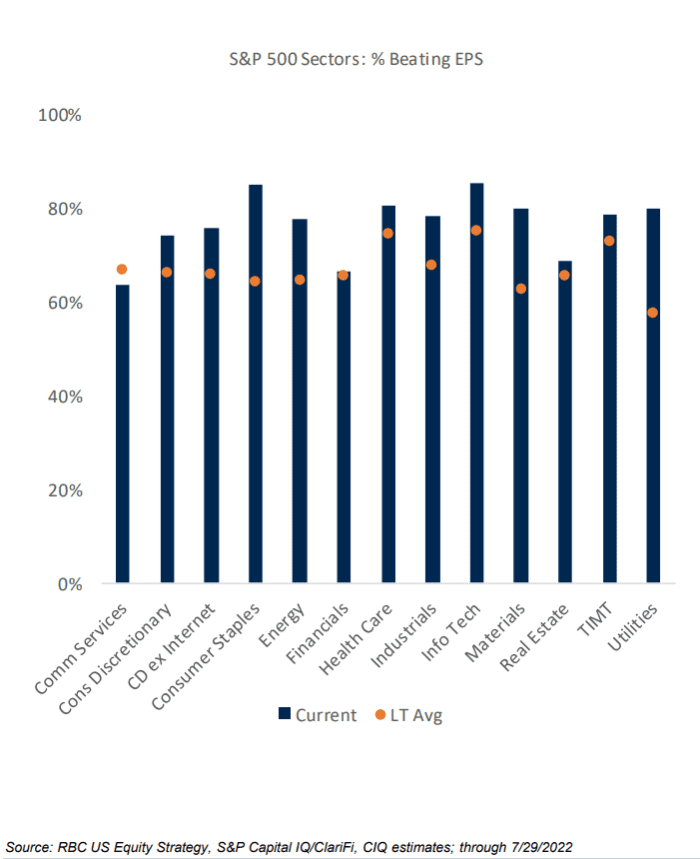
Meanwhile, companies beating on EPS in the second quarter are “being rewarded with some stronger than usual outperformance, and companies that are missing are benefiting from shallower than usual underperformance,” she wrote.
Sector “standouts” so far include energy, real-estate investment trusts and utilities for earnings resilience, with all three areas helping to keep 2022 EPS growth forecasts from “falling too much” for the S&P 500, according to RBC. Technology also stands out, as it’s a sector “where earnings sentiment has already been deeply negative and beat rates have been high” for the second quarter, said Calvasina.
RBC CAPITAL MARKETS NOTE DATED AUG. 3, 2022
“On the flip side, tech has seen one of the highest percentages of negative revisions on both earnings and sales, along with consumer discretionary and communication services,” said Calvasina.
RBC has a “technology overweight as a recession rebound trade,” and recently upgraded energy to overweight and REITs to market weight, according to the note.
U.S. stocks were trading sharply higher Wednesday afternoon, with investors digesting earnings reports and fresh economic data showing factory orders continue to grow in June as the economy decelerates.
The Dow Jones Industrial Average DJIA, +1.29% rose 1.5% in afternoon trading Wednesday, while the S&P 500 SPX, +1.56% gained 1.8% and the tech-heavy Nasdaq Composite COMP, +2.59% jumped 2.7%, FactSet data show, at last check.
“We’ve also been keeping an eye on the labor discussion, where a number of tech firms have highlighted a slowdown in hiring,” said Calvasina. “Outside of tech, however, the conversation about labor still seems to emphasize the challenges companies have finding it.”
from Stock Market News – My Blog https://ift.tt/xtf1gbr
via IFTTT
U.S. equity futures traded higher Wednesday morning, following losses in the prior session as political tensions were in focus over House Speaker Nancy Pelosi’s visit to Taiwan.
Beijing announced a ban on imports of some Taiwanese goods but no immediate major penalties following the arrival of Pelosi.
Oil prices traded lower Wednesday morning ahead of a meeting OPEC+ producers on fears of a slowdown in global growth hitting fuel demand. West Texas Intermediate crude traded around $93.00 a barrel. Brent crude futures were around $99.00 a barrel.
PayPal shares are surging 10% in premarket trading. The online payments company has entered an information sharing agreement with activist investor Elliott Investment Management to evaluate capital return alternatives.
PayPal reported net revenues of $6.8 billion, up 9% year over year in the second quarter and a net loss of $341 million, or 29 cents per diluted share. Last year, the company recorded net income of $1.18 billion, or $1.00 per diluted share.
Airbnb shares dropped more than 7% in premarket trading after the company issued a weaker-than-expected outlook that overshadowed otherwise strong results.
Another busy day coming up for earnings, with a big focus on health care. We’ll hear from CVS Health, AmerisourceBergen, Moderna, and Regeneron Pharmaceuticals ahead of the opening bell. Also watch for hotel and casino play MGM Resorts, online auctioneer Ebay, and household products maker Clorox to name a few.
On the economic calendar, traders will watch for data on the services sector and manufacturing orders.
In Asia, the Shanghai Composite Index lost 0.7%, the Nikkei 225 in Tokyo rose 0.5% and the Hang Seng in Hong Kong added 0.4%.
Wall Street’s benchmark S&P 500 index lost 0.7% on Tuesday after the Labor Department said American employers posted fewer job openings than expected in June following interest rate hikes to cool surging inflation.
The S&P 500 fell to 4,091.19. It is down nearly 1% this week. The Dow Jones Industrial Average lost 1.2% to 32,396.17. The Nasdaq composite slipped 0.2% to 12,348.76.
from Stock Market News – My Blog https://www.techyrack.com/syndication/2022/08/03/stock-market-news-ebay-shares-up-clorox-down-nasdaq-leads-rally-ford-shares-soar-fox-business/
via IFTTT
Stocks finished lower on Tuesday following a volatile trading session that saw the Nasdaq gain over 1% at its highs and the Dow ultimately lose more than 1%.
When the closing bell rang on Tuesday, the S&P 500 was down 0.66%, the Dow off 1.22%, and the Nasdaq down 0.16%.
Stocks opened Tuesday’s session lower with traders citing rising U.S.-China tensions amid House Speaker Nancy Pelosi’s trip to Taiwan as the source of market stress.
Stocks around the globe were lower overnight on Tuesday ahead of this trip, with Europe’s major indexes red across the board as Hong Kong’s Hang Seng fell 2.3% and stocks in Shanghai lost over 2.2%. Japan’s Nikkei fell 1.4% overnight.
Economic data out Tuesday on the labor market showed a slowdown in the number of jobs open as of June, with the latest Job Opening and Labor Turnover survey showing 10.7 million jobs were available at the start of the summer. This marked the fewest number of jobs open since September 2021.
Federal Reserve officials have in recent months talked about slowing the pace of job openings as a way to cool demand in the labor market and the broader economy without causing a surge in unemployment.
On the earnings front, Uber (UBER) shares rallied after the company reported a better-than-expected quarter across the board. Shares gained as much as xxxx
The company reported revenue of $8.1 billion on gross bookings of $29.1 billion. Revenue had been expected to come in at $7.4 billion. Adjusted EBITDA also beat estimates, totaling $364 million against expectations for $266 million. Uber also said it recorded $382 million in free cash flow during the second quarter.
From the department of market oddities, shares of Chinese tech firm AMTD IDEA Group (AMTD) were up as much as 300% on Tuesday as shares of AMTD Digital (HKD), a subsidiary of AMTD IDEA, rose as much as 250% and have gained more than 15,000% since going public last month.
In a statement out early Tuesday, AMTD Digital said: “During the period since our initial public offering, the Company noted significant volatility in our ADS price and, also observed some very active trading volume. To our knowledge, there are no material circumstances, events nor other matters relating to our Company’s business and operating activities since the IPO date.”
The rally in the Nasdaq on Tuesday was also being driven by several heavily-battered high-flyers that have been market leaders during some of the recent rally from mid-June lows.
Names like Peloton (PTON), Coinbase (COIN), Roku (ROKU), Palantir (PLTR), and Virgin Galactic (SPCE) were all trading higher on Tuesday, with Peloton leading this group, gaining as much as 12.5% on no news.
On Monday, Bloomberg reported a clerical error by bankers at Barclays could result in some Peloton noteholders earning a more than 1,000% return on investments that had essentially gone bust.
The price of crude oil finished Tuesday little-changed at $94.25 a barrel as the price of gas in the U.S. has now fallen 17% since its mid-June peak to below $4.17 a gallon.
In crypto markets, bitcoin (BTC-USD) was down over 2% early Tuesday but stood near $23,000 as the closing bell rang on Wall Street. A broad move lower in crypto hit markets early Tuesday morning amid the risk off sentiment in financial markets.
Crypto markets were also under pressure following a late Monday hack of the Nomad protocol, which lost nearly all of its funds totaling about $200 million.
In individual stock news, shares of Pinterest (PINS) gained over 11% after activist investor Elliott Management confirmed a stake in the social media company that makes it Pinterest’s largest shareholder.
Elliott also backed Pinterest’s new CEO Bill Ready, calling Ready “the right leader to oversee Pinterest’s next phase of growth.”
This news overshadowed a quarterly report from Pinterest that showed a decline in users as social media players continue to struggle in a shifting digital ad market. Shares of Pinterest had gained as much as 19% in pre-market trading.
The Pinterest logo is displayed on a screen on the floor of the New York Stock Exchange (NYSE) in New York City, U.S., October 20, 2021. REUTERS/Brendan McDermid
On Monday, stocks gave up early gains and closed slightly lower Monday as investors began another busy week of company earnings and economic reports.
Major indexes spent much of Monday’s session flitting between gains and losses before falling in the afternoon.
The S&P 500 fell 11.66 points, or 0.3%, to 4118.63. The Dow Jones Industrial Average shed 46.73 points, or 0.1%, to finish at 32798.40. The technology-focused Nasdaq Composite Index lost 21.71, or 0.2%, to 12368.98.
U.S. stocks mounted a furious recovery in recent weeks, boosted by positive signals from earnings and expectations that the Federal Reserve may not need to raise interest rates as aggressively as once thought, spurring a rally in government bonds alongside stocks.
August’s subdued opening follows a solid rally for stocks last month: July was the best month for the S&P 500 index since November 2020.
But this week’s array of economic reports and company earnings has left traders “a little cautious,” said Lindsey Bell, chief markets and money strategist at Ally Invest.
“Investors are still assessing where we break from here – further to the upside or reverse course,” Bell said.
The benchmark S&P 500 index fell 11.66 points to 4,118.63. It’s coming off a 9.1% gain in July, but remains down 13.6% for the year.
The Dow lost 46.73 points to close at 32,798.40, while the Nasdaq slid 21.71 points to 12,368.98. The Russell 2000 ended down 1.92 points at 1,883.31.
Banks, health care companies and tech stocks were among the biggest weights on the S&P 500.
JPMorgan Chase fell 1%, UnitedHealth Group dropped 1.3% and Intuit slid 1.7%.
Meanwhile, Asian stocks were lower on Tuesday.
Japan’s Nikkei slid 1.54%, while Taiwan’s stock index dropped 1.87%. Chinese blue chips tumbled 2.47% and Hong Kong’s Hang Seng lost 2.71%.
Australian stocks pared declines and the Aussie dollar weakened after the central bank raised the key rate by an as-expected 50 basis points, with markets interpreting changes to the accompanying policy statement as dovish.
“We knew from the onset that (Pelosi’s trip) would be a driver of risk-off sentiment in the region,” said Carlos Casanova, the senior Asia economist at Union Bancaire Privee in Hong Kong.
from Stock Market News – My Blog https://ift.tt/Cy04IMa
via IFTTT
This copy is for your personal, non-commercial use only. Distribution and use of this material are governed by
our Subscriber Agreement and by copyright law. For non-personal use or to order multiple copies, please contact
Dow Jones Reprints at 1-800-843-0008 or visit www.djreprints.com.
https://ift.tt/i3c5Ihz
from Stock Market News – My Blog https://ift.tt/23IGOmc
via IFTTT
Stock futures rose on Thursday evening as Wall Street looked to finish the week higher, fueled by strong quarterly reports from key tech companies.
S&P 500 futures climbed 0.5%, while Nasdaq 100 futures added 1%. Futures tied to the Dow Jones Industrial Average were flat.
Futures were supported by gains in extended trading by two of the market’s biggest stocks. Shares of Amazon and Apple moved higher after showing strong sales growth in cloud computing and iPhones, respectively, in their most recent quarters.
The move in futures comes on the heels of a second-straight rally for stocks. The Dow is now up nearly 2% for the week, while the S&P 500 the Nasdaq Composite are up 2.8%.
“The market is taking on a hope that slowing economic growth is going to result in a more dovish Fed moving forward, even if it’s a little further out. So it would make sense to me that weaker rates expectations moving forward would result in a little buoyancy in the equity markets,” said Lauren Goodwin, economist and portfolio strategist of New York Life Investments.
However, Goodwin cautioned that the unusual economic environment and the long period before the next Fed meeting make it difficult to predict the central bank’s path from here.
Investors will get updated looks at a key inflation reading and second-quarter employment costs on Friday, which could be key data points for the Fed as it considers its next move.
Investors have also been navigating a mixed batch of earnings reports this week. Shares of Roku sank more than 20% in after hours trading after the company missed estimates and warned of a slowdown in advertising. Chipmaker Intel dropped 7% after its quarterly results fell short of expectations.
On Friday, key earnings include Chevron, Exxon Mobil and Procter & Gamble.
from Stock Market News – My Blog https://ift.tt/0a67HTs
via IFTTT
— Mike Wilson, chief U.S. equity strategist and CIO, Morgan Stanley
Morgan Stanley’s Mike Wilson, who correctly called the stock market’s 2022 swoon, isn’t convinced the lows are in after major U.S. indexes scored a big gain following Wednesday’s Federal Reserve decision to raise rates by another 75 basis points, or three-quarters of a percentage point, to 2.25% to 2.5%.
The Nasdaq Composite COMP, +1.08% surged more than 4% Wednesday, while the Dow Jones Industrial Average DJIA, +1.03% jumped 436 points, or 1.4%, and the S&P 500 SPX, +1.21% advanced 2.6%.
Investors found reason to cheer after Fed chair Jerome Powell said that while another 75-basis-point move in September was possible, the decision would depend on forthcoming economic data. While Powell asserted the Fed would bring stubbornly high inflation down and that the economy would need to see below-trend growth, traders saw prospects for the Fed to slow the pace of rate increases and no reason to budge their expectations for the federal funds rate to ultimately top out somewhere south of 3.5%.
Stocks wobbled in early trade Thursday, but ended with another round of sharp gains as investors digested an estimate of second-quarter gross domestic product that showed the U.S. economy contracted an 0.9% annual pace. That follows a 1.6% contraction in the first three months of the year and highlights fears of a sharp slowdown in economic growth and the potential for recession, but also served to reinforce market expectations the Fed will soon slow the pace of tightening, analysts said.
Stocks have fallen sharply in 2022, with the S&P 500 and Nasdaq entering bear markets, as the Fed has moved to aggressively hike rates in its effort to rein in inflation. However, Wednesday’s jump was in line with the pattern seen on the three previous days when the Fed delivered rate hikes in 2022. Such jumps have often been followed by pullbacks.
Wilson, in a CNBC interview late Wednesday, said expectations that the pace of rate hikes is set to slow are premature. Wilson echoed a warning from a note published earlier this week, in which he argued that a past pattern that’s seen stocks rally in the time between a final Fed rate hike and the onset of a recession may not be in play in the current cycle. That’s because the Fed may find itself continuing to hike interest rates right into a recession as it attempts to get a grip on inflation.
Wilson has a 3,900 year-end target for the S&P 500, which is around 3% below Wednesday’s finish. He’s also warned the S&P 500 could take out the 2022 low near 3,636 set in mid-June and could drop as low as 3,000 if a recession does take hold.
The bear market may be getting “close to the end” but needs to have “that final move, and I don’t think the June low is the final move,” he told CNBC.
from Stock Market News – My Blog https://ift.tt/qGpOyBt
via IFTTT
A trader works on the floor of the New York Stock Exchange (NYSE) following a Fed rate announcement, in New York City, July 27, 2022.
Brendan McDermid | Reuters
Here are the most important news items that investors need to start their trading day:
1. Stock futures look soft
U.S. equities markets were set for a weak open Thursday following Wednesday’s broad rally. Investors are chewing on the latest round of earnings, which included Facebook parent Meta on Wednesday afternoon and NBCUniversal parent Comcast on Thursday morning. The Federal Reserve on Wednesday decided to hike rates by three-quarters of a point, in line with expectations, to battle a four-decade-high surge in inflation. Fed Chair Jerome Powell also indicated that the central bank could slow the pace of its rate hikes.
2. GDP and recession vibes
Federal Reserve Board Chairman Jerome Powell speaks during a news conference following a two-day meeting of the Federal Open Market Committee (FOMC) in Washington, July 27, 2022.
Elizabeth Frantz | Reuters
3. JetBlue gets its way
LaGuardia International Airport Terminal A for JetBlue and Spirit Airlines in New York.
Leslie Josephs | CNBC
It didn’t take long for things to fall into place for JetBlue after Spirit scuttled its deal with fellow low-cost airline Frontier. On Thursday morning, Spirit and JetBlue said they reached a deal. If the acquisition is finalized, the combination of JetBlue and Spirit would create the fifth-largest carrier in the United States. But the agreement faces significant regulatory hurdles, as the Biden administration pushes a hard line on mergers and acquisitions. CNBC’s airlines reporter Leslie Josephs breaks it down here.
4. Reality bites Meta
Facebook parent Meta reported earnings after the bell Wednesday, and they weren’t pretty. Financial results missed expectations pretty much across the board. Its metaverse and virtual reality unit suffered a fat $2.8 billion loss in the second quarter, and it’s expected to post even lower revenue in the third. The bigger immediate concern, though, is advertising revenue. And just like social media rivals Snap and Twitter, Meta, which also owns Instagram, said a slowdown in the economy is weighing on the ad business. “It’s always hard to predict how deep or how long these cycles will be, but I’d say that the situation seems worse than it did a quarter ago,” CEO Mark Zuckerberg told analysts in a call.
5. Manchin and Schumer actually reach a deal
U.S. Senator Joe Manchin (D-WV) walks to the Senate floor at the U.S. Capitol in Washington, June 7, 2022.
Jonathan Ernst | Reuters
Washington is notoriously slow to get things done, especially when Congress is involved. But sometimes there are surprises, too, like the out-of-nowhere deal Wednesday evening between Senate Majority Leader Chuck Schumer, D-N.Y., and conservative West Virginia Democratic Sen. Joe Manchin. Just weeks ago, Manchin had balked at a reconciliation package due to his concerns over inflation. The new measure, which is designed to pass the Senate with a simple majority, includes provisions for health care and climate change, as well as deficit reduction (including a minimum corporate tax). CNBC’s Emma Newburger explains the climate provisions in the bill here.
– CNBC’s Samantha Subin, Carmen Reinicke, Patti Domm, Leslie Josephs, Emma Newburger, Jonathan Vanian, Kevin Breuninger and Jordan Novet contributed to this report.
— Sign up now for the CNBC Investing Club to follow Jim Cramer’s every stock move. Follow the broader market action like a pro onCNBC Pro.
from Stock Market News – My Blog https://ift.tt/es6Ql0N
via IFTTT
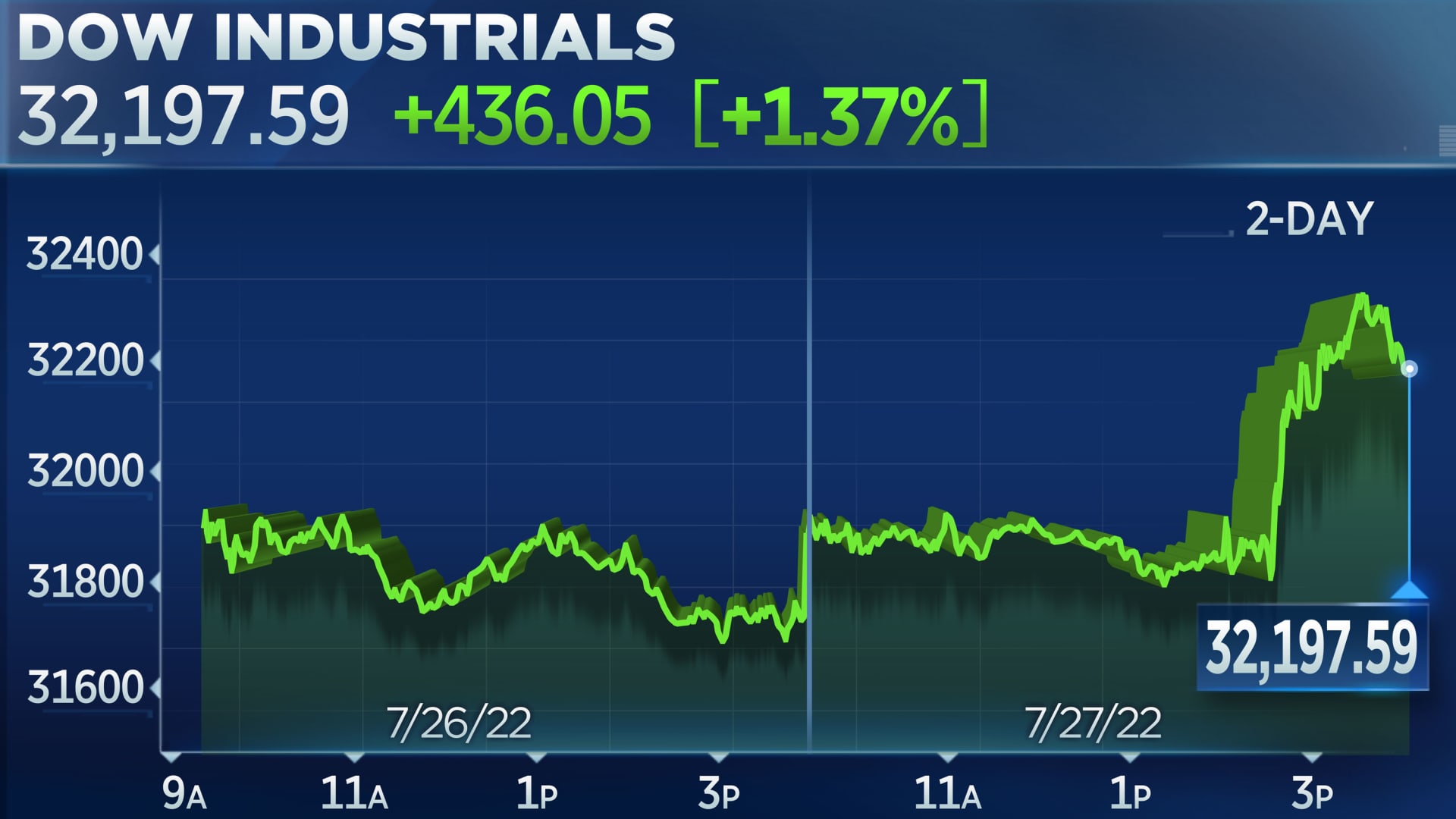
The Dow Jones Industrial Average jumped 436.05 points, or nearly 1.4%, to 32,197.59. The S&P 500 gained 2.62% to close at 4,023.61. The Nasdaq Composite climbed 4.06% to 12,032.42. Tech shares led gains a day after quarterly results from Alphabet and Microsoft.
Stocks hit their highs of the session in the afternoon as Fed Chairman Jerome Powell left the door open about the size of the central bank’s rate move at its next meeting in September and noted it would eventually slow the magnitude of rate hikes. Powell said in a press conference that the Fed could hike by 0.75 percentage point again in September, but that it would be dependent on the data.
Loading chart…
“As the stance of monetary policy tightens further, it likely will become appropriate to slow the pace of increases while we assess how our cumulative policy adjustments are affecting the economy and inflation,” he said.
Investors were also encouraged after Powell noted that he doesn’t believe the economy is currently in a recession. The second-quarter GDP reading is due on Thursday.
Investors have continued to worry that the central bank’s ongoing efforts to lower inflation will push the economy into a recession, or that we may already be in one. Those fears eased Wednesday after Powell said he does not think the U.S. is currently in a recession, adding that “there are too many areas of the economy that are performing too well.”
“The reason this is providing some relief to the equity market is the Fed is acknowledging that there can be an impact on growth to the economy based on their policy,” said Gargi Chaudhuri, head of BlackRock’s iShares investment strategy for the Americas. “They’re recognizing there are two sides of this: there’s a growth tradeoff to fight inflation. That recognition is something we had today that we didn’t hear before.”
Many regard two consecutive quarters of negative GDP readings as a recession, but the National Bureau of Economic Research, the official arbiter of recessions, uses multiple other factors to determine one. The GDP reading Thursday is expected to show barely an expansion after first-quarter GDP declined by 1.6%.
Stocks started the day on a high note after getting a boost from tech earnings. Tech stocks added to those gains as the overall market rallied.
Alphabet shares rose about 7.7% after the tech giant’s quarterly report showed strong revenue from Google’s search business. Microsoft gained close to 6.7% after reporting a 40% jump in revenue growth for Azure and cloud services. The gains came even after both companies posted earnings and revenue that fell below analyst estimates.
Meta Platforms shares rose nearly 6.6%, ahead of its earnings scheduled for after the bell. Amazon advanced more than 5% after getting hit by the retail carnage Tuesday. Apple added 3.4%.
Retailers rallied too as inflation concerns softened Wednesday afternoon. Walmart, which led retail declines in the previous session, climbed about 3.8%. Kohl’s, Ross Stores and Costco added more than 2% each. The SPDR S&P Retail ETF advanced roughly 2.6%.
Enphase Energy also popped on the back of its latest results, ending the day about 17.9% higher. Chipotle added 14.7% following its mixed second-quarter earnings release.
U.S. stocks fell Tuesday after Walmart cut its earnings forecast, sending other retail shares lower and adding to concern that consumer spending might not be strong enough to keep the U.S. out of a recession.
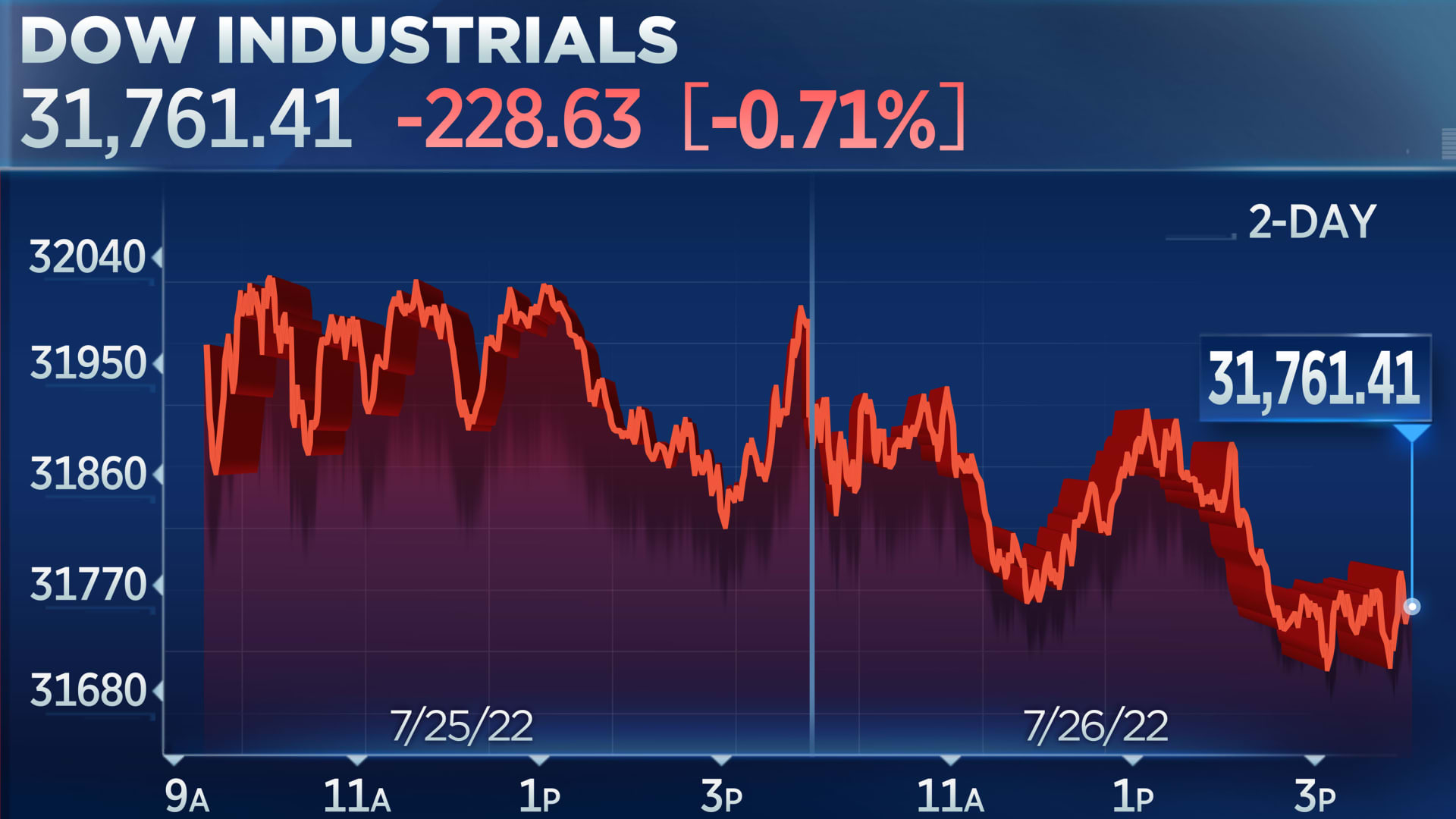
The Dow Jones Industrial Average fell 228.50 points, or 0.71%, to 31,761.54. The S&P 500 retreated by 1.15% to 3,921.05. The Nasdaq Composite declined about 1.87% to 11,562.57. All of the major averages were still on pace for their best month of 2022.
Walmart cut its quarterly and full-year profit estimates because of rising food inflation. This alarmed investors who deliberated the implications for other retail stocks. The big-box retailer said higher prices are spurring consumers to pull back on general merchandise spending, particularly in apparel.
Walmart plunged 7.6% Tuesday and dragged other retailers with it. Kohl’s and Target dropped 9.1% and 3.6%, respectively. Among apparel companies, Macy’s was among the hardest hit, down 7.2%. Nordstrom and Ross each lost more than 5%, and TJX Companies shed about 4.2%. The SPDR S&P Retail ETF fell nearly 4.2%.
“The most important thing from the Walmart announcement is how inflation is changing what people buy,” said Robert Cantwell, portfolio manager at Upholdings. “Food now makes up a bigger share of individuals’ budgets, but overall spending still generally remains intact.”
The retail turmoil bled into e-commerce stocks. Shopify tumbled about 14.1% after the payments provider announced it’s laying off about 10% of its global workforce, citing a pullback in online spending and saying it misjudged how long the pandemic-fueled e-commerce boom would last. The company will report its earnings Wednesday.
Amazon fell 5.2%. Square parent Block and PayPal, both of which operate major merchant services businesses, dropped roughly 7.1% and 5.7%, respectively.
Inflation has also changed the cost of production for companies like General Motors. Its shares fell 3.4% after the company missed earnings estimates, blaming supply chain disruptions that forced factory shutdowns and led it to ship fewer vehicles than expected.
UPS shares also slid 3.4% after the shipping giant reported declines in its international and supply chain businesses.
On the flip side, Coca-Cola shares rose 1.6% after the beverage giant topped earnings and revenue expectations, citing a sales volume recovery from the pandemic and higher pricing.
Shares of McDonald’s added nearly 2.7% following mixed second-quarter results, in which net sales were hurt in part by the closure of locations in Russia and Ukraine, but international growth elsewhere fueled a rise same-store sales.
Industrial stocks were earnings winners, too. Shares of 3M rose 4.9% after the company beat earnings and revenue estimates and announced plans to spin its health care business into a separate publicly traded company. General Electric posted better-than-expected results, citing recovery in the aviation industry that boosted its jet engine business. Its shares gained 4.6%.
Traders are also bracing for an onslaught of megacap tech earnings and economic data this week, as well as the outcome of the Federal Reserve meeting, that will help Wall Street direct its expectations for the rest of the year.
“There is this moderating of earnings expectations,” said Stephanie Lang, chief investment officer of Homrich Berg. “The overall corporate sentiment seems to be declining, there is a lot of cautionary commentary around inflation, the dollar”
“As the Fed continues on its trajectory with its main goal to weaken demand for goods and services, that will translate into a weaker top line – if they are able to get inflation under control and temper that demand,” she added. “That’s something we would be concerned about for the second half of this year.”
Fed meeting and the market’s expectations
On Tuesday, the Federal Reserve commenced its two-day policy meeting. Traders are widely expecting a three-quarter percentage point hike and will be looking for clues on the future interest rate path and what it could mean for equity market pricing.
“The bottom line is the Fed, no matter how you cut it, is going to quickly move to that restrictive stance that will have a toll on the economy,” Lang said. “It’s going to get there quickly enough, whether it’s an extra 25 basis points next time versus a month later. Within the next six months we’re going to be in a financially restrictive environment.”
The Dow Jones Industrial Average jumped 436.05 points, or nearly 1.4%, to 32,197.59. The S&P 500 gained 2.62% to close at 4,023.61. The Nasdaq Composite climbed 4.06% to 12,032.42. Tech shares led gains a day after quarterly results from Alphabet and Microsoft.
Stocks hit their highs of the session in the afternoon as Fed Chairman Jerome Powell left the door open about the size of the central bank’s rate move at its next meeting in September and noted it would eventually slow the magnitude of rate hikes. Powell said in a press conference that the Fed could hike by 0.75 percentage point again in September, but that it would be dependent on the data.
Loading chart…
“As the stance of monetary policy tightens further, it likely will become appropriate to slow the pace of increases while we assess how our cumulative policy adjustments are affecting the economy and inflation,” he said.
Investors were also encouraged after Powell noted that he doesn’t believe the economy is currently in a recession. The second-quarter GDP reading is due on Thursday.
Investors have continued to worry that the central bank’s ongoing efforts to lower inflation will push the economy into a recession, or that we may already be in one. Those fears eased Wednesday after Powell said he does not think the U.S. is currently in a recession, adding that “there are too many areas of the economy that are performing too well.”
“The reason this is providing some relief to the equity market is the Fed is acknowledging that there can be an impact on growth to the economy based on their policy,” said Gargi Chaudhuri, head of BlackRock’s iShares investment strategy for the Americas. “They’re recognizing there are two sides of this: there’s a growth tradeoff to fight inflation. That recognition is something we had today that we didn’t hear before.”
Many regard two consecutive quarters of negative GDP readings as a recession, but the National Bureau of Economic Research, the official arbiter of recessions, uses multiple other factors to determine one. The GDP reading Thursday is expected to show barely an expansion after first-quarter GDP declined by 1.6%.
Stocks started the day on a high note after getting a boost from tech earnings. Tech stocks added to those gains as the overall market rallied.
Alphabet shares rose about 7.7% after the tech giant’s quarterly report showed strong revenue from Google’s search business. Microsoft gained close to 6.7% after reporting a 40% jump in revenue growth for Azure and cloud services. The gains came even after both companies posted earnings and revenue that fell below analyst estimates.
Meta Platforms shares rose nearly 6.6%, ahead of its earnings scheduled for after the bell. Amazon advanced more than 5% after getting hit by the retail carnage Tuesday. Apple added 3.4%.
Retailers rallied too as inflation concerns softened Wednesday afternoon. Walmart, which led retail declines in the previous session, climbed about 3.8%. Kohl’s, Ross Stores and Costco added more than 2% each. The SPDR S&P Retail ETF advanced roughly 2.6%.
Enphase Energy also popped on the back of its latest results, ending the day about 17.9% higher. Chipotle added 14.7% following its mixed second-quarter earnings release.
The Dow Jones Industrial Average jumped 436.05 points, or nearly 1.4%, to 32,197.59. The S&P 500 gained 2.62% to close at 4,023.61. The Nasdaq Composite climbed 4.06% to 12,032.42. Tech shares led gains a day after quarterly results from Alphabet and Microsoft.
Stocks hit their highs of the session in the afternoon as Fed Chairman Jerome Powell left the door open about the size of the central bank’s rate move at its next meeting in September and noted it would eventually slow the magnitude of rate hikes. Powell said in a press conference that the Fed could hike by 0.75 percentage point again in September, but that it would be dependent on the data.
Loading chart…
“As the stance of monetary policy tightens further, it likely will become appropriate to slow the pace of increases while we assess how our cumulative policy adjustments are affecting the economy and inflation,” he said.
Investors were also encouraged after Powell noted that he doesn’t believe the economy is currently in a recession. The second-quarter GDP reading is due on Thursday.
Investors have continued to worry that the central bank’s ongoing efforts to lower inflation will push the economy into a recession, or that we may already be in one. Those fears eased Wednesday after Powell said he does not think the U.S. is currently in a recession, adding that “there are too many areas of the economy that are performing too well.”
“The reason this is providing some relief to the equity market is the Fed is acknowledging that there can be an impact on growth to the economy based on their policy,” said Gargi Chaudhuri, head of BlackRock’s iShares investment strategy for the Americas. “They’re recognizing there are two sides of this: there’s a growth tradeoff to fight inflation. That recognition is something we had today that we didn’t hear before.”
Many regard two consecutive quarters of negative GDP readings as a recession, but the National Bureau of Economic Research, the official arbiter of recessions, uses multiple other factors to determine one. The GDP reading Thursday is expected to show barely an expansion after first-quarter GDP declined by 1.6%.
Stocks started the day on a high note after getting a boost from tech earnings. Tech stocks added to those gains as the overall market rallied.
Alphabet shares rose about 7.7% after the tech giant’s quarterly report showed strong revenue from Google’s search business. Microsoft gained close to 6.7% after reporting a 40% jump in revenue growth for Azure and cloud services. The gains came even after both companies posted earnings and revenue that fell below analyst estimates.
Meta Platforms shares rose nearly 6.6%, ahead of its earnings scheduled for after the bell. Amazon advanced more than 5% after getting hit by the retail carnage Tuesday. Apple added 3.4%.
Retailers rallied too as inflation concerns softened Wednesday afternoon. Walmart, which led retail declines in the previous session, climbed about 3.8%. Kohl’s, Ross Stores and Costco added more than 2% each. The SPDR S&P Retail ETF advanced roughly 2.6%.
Enphase Energy also popped on the back of its latest results, ending the day about 17.9% higher. Chipotle added 14.7% following its mixed second-quarter earnings release.
The fact that the S&P 500 is now flirting with the 4,000 level after clinching its second weekly gain out of the last three weeks has got some of Wall Street’s most prominent bears wondering what exactly is driving this latest rebound — and whether it’s a bear-market rally, or if the bottom is, indeed, in.
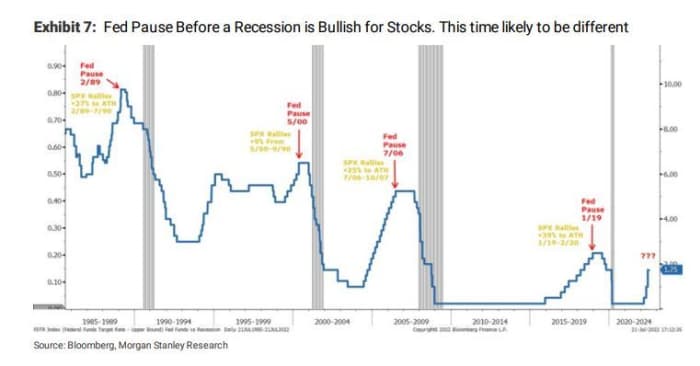
In his latest note, Morgan Stanley’s Michael Wilson — the head of U.S. equity research who was one of the few people on Wall Street to correctly anticipate this year’s selloff — suggested that equity investors have perhaps been a little too eager to price in a “pause” to the Fed’s rate-hike cycle this week.
During the past few Fed tightening cycles, there has typically been a pause between the end of the Fed’s rate hikes and the start of a recession. But with inflation running at its highest level in 40 years, and leading indicators suggesting that growth is already slipping, Wilson believes that the situation will likely be different this time around.
The question, now, is whether the Federal Reserve will halt its rate hikes later this year in an attempt to save the economy from a punishing recession. Fed Chairman Jerome Powell has already acknowledged that the Fed’s rate hikes could drive the economy into a recession, although he has insisted that this isn’t the Fed’s goal — rather, the central bank is hoping to engineer a “soft landing” that will see the unemployment rate move toward 5%, enough to blunt demand in a way that would undercut inflation.
Source: Morgan Stanley
And while Wilson believes that markets are likely correct in assuming that inflationary pressures have likely already peaked (given the recent weakness in commodity prices), the notion that the Fed could stave off a recession by dialing back rate hikes later this year seems more like wishful thinking.
“While we appreciate that the market (and investors) may be trying to leap ahead here to get in front of what could be a bullish signal for equity valuations, we remain skeptical that the Fed can reverse the negative trends for demand that are now well established,” Wilson said.
Morgan Stanley isn’t the only bank wondering whether markets have been too quick to price in the possibility that the Federal Reserve could start cutting interest rates as soon as February (which is what Fed funds futures markets currently suggest, according to the CME’s FedWatch tool).
Economists at Deutsche Bank speculated last week that the Fed won’t be able to start cutting rates again until the official data reflect a sharp slowdown in price pressures while unemployment moves above 6%.
Former Richmond Federal Reserve President Jeffrey Lacker expressed a similar view on Friday. He said that the Fed will likely need to continue hiking rates into a recession, and that the Fed funds rate would likely need to surmount the rate of core inflation — which presently stands at just under 6% — to effectively constrain inflation. Of course, Fed funds traders don’t expect the benchmark rate to rise anywhere close to this level.
Wilson also claimed that stocks could face headwinds as expectations for corporate earnings over the next year continue to weaken as inflation saps consumer spending power while increasing input costs for corporations. Right now, more analysts are cutting expectations for S&P 500 sector earnings than are raising them, which is another reason to favor “defensive” growth stocks over the megacap tech stocks that led the market higher for years after the Great Financial Crisis, and have also led the latest rebound.
Depending on the sector, analysts have cut earnings expectations over the next 12 months by a range of 28% to a whopping 45%. Transportation, materials, insurance and consumer durables are seeing the biggest downward revisions.
For now, at least, stocks appear content to grind higher despite the event risk lying ahead: in addition to this week being the busiest week for corporate earnings, the Federal Reserve is expected to announce its next rate hike Wednesday following the conclusion of its latest two-day policy meeting.
The S&P 500 SPX, +0.13% was up 0.2% in recent trading, while the Dow Jones Industrial Average DJIA, +0.28% was up 0.3%. Only the Nasdaq Composite COMP, -0.43% was lower on the day, down 0.2%.
from Stock Market News – My Blog https://ift.tt/75vMHwB
via IFTTT
A summer rebound is stirring hopes the bear market in U.S. stocks has seen its lows, but a meeting of Federal Reserve policy makers this coming week might test the nerves of would-be bulls.
“I expect we will continue to see market volatility until investors have seen more convincing evidence that this period of Fed hawkishness is behind us, and I do not expect that to be the message” when central bankers conclude a two-day meeting on July 27, said Lauren Goodwin, economist and portfolio strategist at New York Life Investments, in a phone interview.
Disappointing results from social-media platform Snap Inc. SNAP, -39.08% trimmed a weekly rise in stocks on Friday, but the benchmark indexes still saw healthy gains. The S&P 500 SPX, -0.93% rose 2.6% in the past week to end near 3,962 after pushing above the 4,000 threshold early Friday for the first time since June 9. The Dow Jones Industrial Average DJIA, -0.43% logged a weekly gain of 2%, while the Nasdaq Composite COMP, -1.87% advanced 3.3%.
The bounce this week lifted the indexes off 2022 lows after the S&P 500 sank to a finish of 3,666.67 on June 16.
The rebound has been fueled in part by a dynamic that’s seen investors treat bad news on the economic front as good news for stocks, said James Reilly, an economist at Capital Economics, in a Friday note.
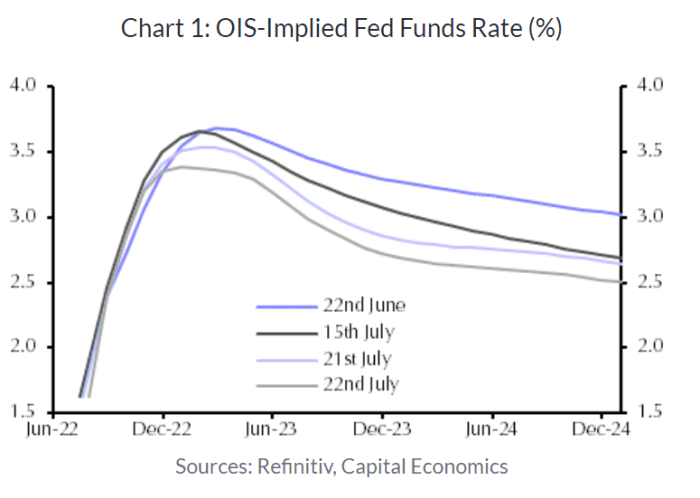
That may sound strange, but it likely reflects, in part, a view among investors that weaker economic data will lead the Fed to raise interest rates less than previously thought, Reilly wrote. There’s evidence for that in market-based expectations for rate increases, which have been pared back lately (see chart below), a development that has provided support for equity valuations, he said.
Capital Economics
Market expectations are for the Fed to deliver a 75 basis point interest rate increase on Wednesday, matching the increase seen in June, which was the largest since 2002.
Meanwhile, the past week delivered plenty of evidence of slowing economic activity.
The U.S. services purchasing managers index fell to a 26-month low of 47 in July from 51.6 in the prior month, based on a “flash” survey from S&P Global Market Intelligence. A reading of less than 50 signals a contraction in activity.
U.S. economic data due next week include a first estimate of second-quarter gross domestic product, that’s expected to show a second straight contraction. While such an outcome is often described as a technical recession, a still strong labor market and other factors are seen making it unlikely the National Bureau of Economic Research, the official arbiter of the business cycle, will declare one.
Reilly said he doubts slowing activity will slow the Fed’s roll.
“Our central forecast is that U.S. economic growth will remain weak, but not so weak as to deter the Fed from hiking aggressively over the rest of this year. Such an outcome would probably mean rising discount rates and disappointing growth in corporate profits, which would be a fairly toxic combination for equity prices,” he wrote.
Many Fed watchers, including some ex-policy makers, see a Fed intent on convincing market participants of its desire to snuff out inflation.
Former Richmond Fed President Jeffrey Lacker on Friday said policy makers would need to keep raising interest rates even if there is a recession. “To let your foot up off the brake before inflation has come down” is just a “recipe for another recession down the road,” Lacker said, in an interview on Bloomberg Television.
Even if the economy slowed fast enough to cause Fed policy makers to back off, it probably wouldn’t be great news for equities, Reilly argued. That’s because corporate earnings would weaken further than the firm already expects, he said. It’s also unlikely that the support equities have seen as expectations for the fed-funds rate have moderated would continue in a severe slowdown, with history showing that valuations have tended to fall during such periods as appetite for risk deteriorated.
Goodwin, however, said there’s more to the stock market’s recent resilience.
“The market, on average, was anticipating a tougher earnings season than what we’re seeing so far,” while guidance has also been more upbeat, she said, acknowledging that it’s still early days.
Through Friday morning, 75.5% of the S&P 500 companies that had reported have beaten consensus analyst projections for earnings per share. The average was by about 4.7%, according to I/B/E/S data provided by Refinitiv. That compares with 66% of companies beating EPS estimates in a typical quarter since 1994, and an average beat margin of 9.5% for the prior four quarters.
On revenue, 68.9% of the companies have topped forecasts by an average of about 1.3%, compared with 62% of companies beating in a typical quarter since 2002 and an average beat rate of 3.4% for the prior four quarters.
Markets have been dominated by worries over red-hot inflation and the threat of recession, so a “somewhat more sanguine” read from companies so far was a dose of good news, Goodwin said.
Indeed, investors have seemed to cycle between fears over inflation and recession, market watchers said. Red-hot inflation was the dominant worry as stocks tumbled and Treasury yields soared in the first half of 2022. More recently, market action indicates investors have focused more on the prospect of recession as the Fed aggressively tightens policy.
So what should investors do as the focus shifts from inflation toward recession ?
Goodwin said inflation will remain a primary consideration when it comes to portfolio positioning because recession-resilient assets, such as cash, Treasurys and high-grade corporate bonds that worked in the last cycle can create a significant drag on wealth creation.
To deal with expected volatility, New York Life is moving up in quality within asset classes. For example, it’s strongly overweight high-yield debt in its portfolios on expectations the corporate environment will remain pretty robust, she said, but is moving up in quality within high yield.
Keeping rising consumer prices in mind, it also means looking at equity and fixed-income securities that have cash flows linked to inflation, she said.
from Stock Market News – My Blog https://ift.tt/x5Qe8Iv
via IFTTT
The key is that Netflix eked out a positive number for operating cash flow in the quarter, despite spending $1.3 billion more on content than it did in the first three months of this year, as it launched a new series of its “Stranger Things” franchise and wrapped up its $200 million “The Gray Man” action thriller. For the first half of the year, Netflix said it made $1 billion in cash flow – a number analysts say will double, and may triple, by 2023.
“Netflix’s revenue will grow 10% to 15% next year, but the content spend will grow zero,” said Robert Cantwell, manager of the Compound Kings Exchange Traded Fund in Nashville, which has 3.9% of its fund in Netflix stock as of July 19. “You’ll see $3 billion to $3.5 billion next year in free cash flow.”
Critics have long zeroed in on the fact that Netflix’s spending on new movies and TV shows has been more than its reported profits because of accounting rules that let the content investment be reported as expenses over several years. But that ended in the first quarter of this year, and was sustained in the second even with the extra spending.
Netflix said on its quarterly earnings presentation that it will keep content spending level at about $17 billion annually for the next couple of years. Two executives said spending would stay “in that zip code.” That’s up from $11.8 billion in 2020, and little changed from $17.7 billion last year.
The company spent most of earnings call talking about its plans to add an advertising supported tier to its service offerings, letting Netflix cash in on households that don’t want to pay $10 to $20 a month for a subscription. Many of those households are using passwords belonging to friends or family, skirting Netflix’s rules.
The combination of leveling off content spending and adding ad revenue is where the cash flow increase will come from, according to Cantwell and Evercore ISI analyst Mark Mahaney.
Mahaney says Netflix the company should reach $2.5 billion in 2023 cash flow and could reach $4 billion by 2024.
“If you generate $4 billion in cash flow, that’s [more than] a 4% yield,” said Mahaney, a longtime Netflix bull who now rates the shares as a market performer. “That’s solid. On 2023, it’s trading at 45 times free cash flow. That’s not so interesting.”
Neither analyst doubts that Netflix’s ad strategy will work. Competitors like Hulu get about 15% to 20% of revenue from advertising now, Cantwell said, and Mahaney says Netflix should have made this move a couple of years ago.
At Netflix, 20% of sales would be as much as $6 billion a year, for a company whose market cap is about $91 billion now. That revenue would carry gross margin higher than the 40% profit the company’s content business generates now, with less capital investment, Cantwell said.
Because it will take time to build up the ad business, it should contribute $250 million to $300 million to cash flow next year, Cantwell said.
The problem is, the extra cash flow still doesn’t change the fact that Netflix is making a transition from being one of the century’s best growth stocks – its 2002 IPO price, adjusted for stock splits, works out to $1.07 a share, and it went as low as 65 cents later that year – to being a play for value investors who look for fatter earnings and pay lower price-to-earnings multiples to get them.
At the peak, Netflix bulls talked about the company attracting as many as 800 million global subscribers, Cantwell said, up from 221 million now. That ship has likely sailed, he said, as many international markets have proven tougher to crack than some assumed. Netflix has already captured 73 million subscribers in the U.S, and Canada, more than half of the households in the two nations combined.
The cash flow won’t be big enough to really galvanize value investors until 2024 or later, Mahaney said.
“It’s a transition,” he said. “Growth is becoming much more moderate and cash flow is getting much more interesting.”
But growth has been Netflix’s calling card for years, and a reliable magnet to attract content creators, customers and investors alike. With growth slowing, the pace of new content addition leveling off, and its competitive advantages over rivals in technology having closed, the risk is that it will need to relax its newfound spending discipline to stay ahead of rivals like Warner Bros. Discovery‘s HBO Max and Disney Plus, Cantwell said.
“The challenge is that it assumes Netflix can make content that has long-term library value, and that is one of the hardest bets to make about Netflix at this point,” he said. “You’re betting on them to make better content than they have.”
from Stock Market News – My Blog https://ift.tt/QCuALlo
via IFTTT